From Records to Reality: Using Newspaper Accounts to Enrich a 400-Year Schischa Family Narrative
by Carole Garbuny Vogel
Originally published in The IIJG Journal, Issue 3 (Spring 2026)
For more than 40 years. I have worked on the history of my Austro-Hungarian Schischa family, documenting over 18,000 individuals across 15 generations from the 1600s to the present day. I have poured my heart and soul into this project, so I was quite miffed when an English cousin told me it read like a telephone directory. After a day or two, I realized that in my relentless pursuit to identify every descendant of the Schischa family patriarch, Jakob Levy (est. 1600–ca. 1687), I had drained the life out of the story.¹ ²
Data from vital records, censuses, immigration documents, and gravestones had provided the framework for my genealogy but did not capture the drama and individuality that had animated the lives of the people. This problem was partially addressed some 20 years ago when I teamed up with my distant cousin, Rabbi Yitzchok Stroh of Brooklyn. He helped me access a rich trove of Jewish community records written in Hebrew and Yiddish. These records were connected to the hometown of the Schischas (Mattersdorf, Hungary, now Mattersburg, Austria), and provided interesting facts about community members, mainly men.³ Yitzchok and I described these records and how we used them in “Constructing a Town-Wide Genealogy: Jewish Mattersdorf, Hungary 1698-1939,” in AVOTAYNU; The International Review of Jewish Genealogy, Vol. XXIII. No. 1, Spring 2007.⁴
Earlier, in the 1970s, I discovered the richness and surprises of historical newspaper accounts. I had spent an afternoon in the Library of Congress in Washington, D.C., perusing microfilmed newspapers from Berlin, Germany, in search of my father’s family. (My mother is the Schischa descendant.) I found the expected obituary of a great-grandmother and learned her age and maiden name.⁵ There were also numerous notices and advertisements related to the family’s cigarette factory, started by my great-grandfather Jakob Sadunischker (1857–1935) and taken over by my grandfather Efim Garbuny (1880–1987). I also stumbled across the 1910 engagement announcement of my paternal grandmother Elise Sadunsichker to Leo Ricklowitz, published 16 months before her marriage to Efim.⁶ (The cause of Leo and Elise’s breakup is unfortunately unknown.)
Fifty years ago, the logistics of conducting widespread searches of European newspapers on microfilm were overwhelming, especially when they involved a foreign language. Access created the first challenge, but newspaper indexes posed another if they existed at all. Available indexes were limited in scope. They provided broad subject headings, prioritized famous people, and only occasionally included the names of ordinary individuals. Researchers often had to scroll through entire microfilm rolls, page by page, in what was frequently a wild goose chase.
In recent years, however, digitization, searchable online databases, and translation engines have made newspaper research far easier, making it possible to search by a single surname. Sometimes this can be too much of a good thing. A search for the name Schischa produced 1,298 hits between the years 1799 and 1955 in Austria’s largest newspaper database. Adding more specificity to the search, such as a first name, place, and date range, narrowed the results, making them more manageable. I decided, however, to check out each mention, one by one.⁷
The technology behind digitized newspaper research has three main components:
Digitization. Most historic newspapers were preserved on microfilm before the digital era. Modern digitization typically involves scanning these microfilms at a resolution that preserves the available detail. This process produces detailed digital images that capture the text, illustrations and photographs on each page.
Optical character recognition (OCR). OCR converts scanned page images into machine-readable text. It identifies individual words and their positions on the page and recognizes column structure. Generally, it does not segment pages into separate articles.
Keyword Search. Full-text search allows researchers to locate specific names, events, or terms. Search results link directly to the page images, with search terms highlighted. This keyword search is far superior to the old microfilm indexes that typically indexed only major topics. Soon AI will be providing an even more powerful toolset for this work.
I hoped the newspaper articles would capture the human dimension of my Schischa clan. My goal was to enrich the family history by combining a historical narrative with concrete details about the individuals who lived it. The articles did not disappoint. They illuminated moments rarely found in vital records or censuses and transformed individuals from static names into active participants in their own histories.
The historical newspapers offered a rich tapestry of information, including birth notices, marriage proclamations, obituaries, business reports, legal notices, charitable activities, and accounts of community life. Reports of court proceedings, bankruptcies, crimes, disputes, and accidents revealed lives gone awry. Coverage of antisemitism exposed the Jew-hatred that lurked just below the surface of Austrian society and its growing acceptance. Together, these sources revealed enduring patterns of prejudice, perseverance, and adaptation that shaped Jewish family life.
The main search engine I used was ANNO (AustriaN Newspapers Online), available through the Österreichische Nationalbibliothek (Austrian National Library) (https://anno.onb.ac.at). It provides free access to 27 million digitized pages from historical newspapers and magazines, published primarily in Austria and the former Habsburg lands. Dating from the 18th through mid-20th centuries, these newspapers are mainly in German with some in Hungarian, Italian, or Czech. While the main focus here is on Austro-Hungarian resources, the approach can be applied broadly.
For countries outside of the Austro-Hungarian Empire, I used two subscription-based newspaper databases that significantly expanded access to old newspapers. OldNews.com, available through MyHeritage, includes more than 41,500 newspapers worldwide, as of 2026, while Newspapers.com, offered through Ancestry, provides access to more than 30,000 newspapers.
Aufbau, a newspaper for German-Jewish exiles in the United States, was published in New York City between 1934 and 2004. It began as a free, monthly, newsletter for the German Jewish Club, became a fortnightly newspaper with subscriptions and advertisements in 1936, and expanded to a weekly publication in 1939. It served as an important source of information for refugees.⁸ I found its announcements of births, engagement, marriage, death, and special occasion news especially useful. Indexing for the Aufbau is underway and the existing index to date can be accessed at https://www.calzareth.com/aufbau/search.html.
Many other newspaper databases exist, but this article focuses on how newspaper sources can be used to reconstruct lives, not on compiling an exhaustive list of repositories. Their value becomes clear when we look closely at the kinds of stories they preserve.
Newspaper Articles: Reflecting Everyday Life
Marriage Proclamations
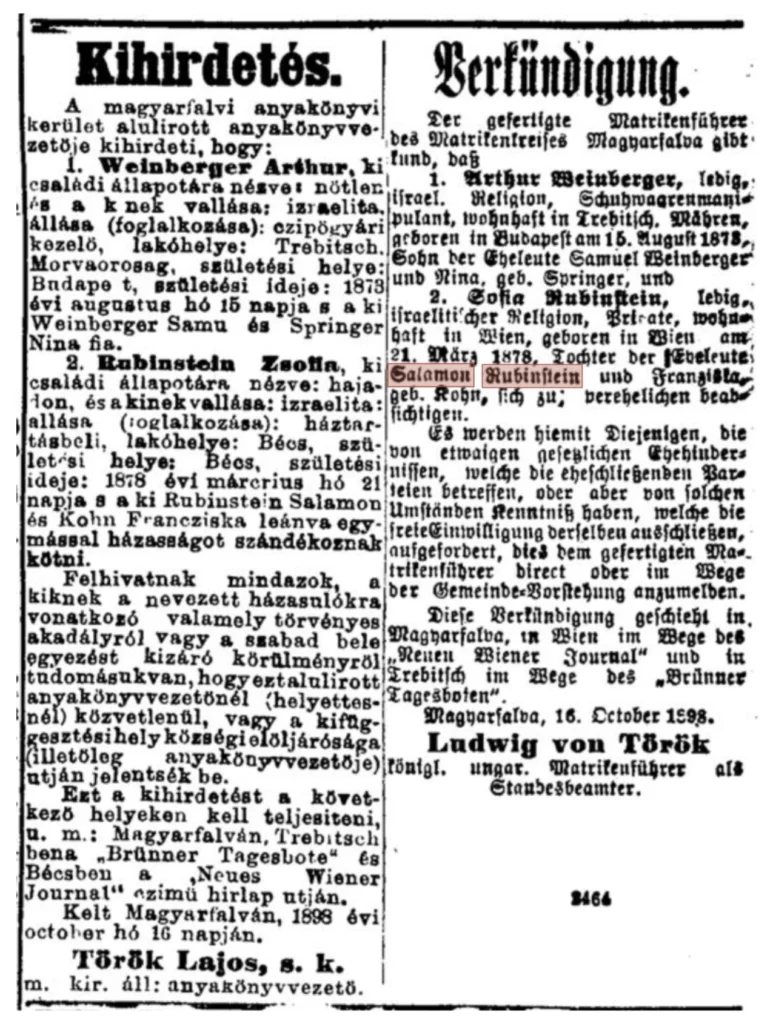
Proclamations provided the names of the bride and groom and invited anyone aware of a legal impediment to the marriage to report it to the civil registrar. They were required to be publicly posted by the civil registrar in the municipalities connected with the couple, including the registrar’s district and the towns where the bride or groom lived. Proclamations were displayed in official public locations and sometimes published in newspapers, particularly when the bride and groom resided in different localities. This ensured that anyone aware of a legal impediment had an opportunity to come forward.
The proclamations often appeared in newspapers under the headings Aufgebot (German) or Kihirdetés (Hungarian). They typically listed the couple’s marital status, religion, occupation, place of residence, birthplace, date of birth, and their parents’ names. The proclamations are especially useful for tracking individuals who left no discernable paper trail. For example, Sofie Rubinstein, a Schischa family member born in Vienna in 1878, does not appear in Austrian marriage or death records, nor in immigration records outside Europe. However, a marriage proclamation published in a Vienna newspaper revealed that she had become engaged to Arthur Weinberger, who lived in Trebitsch, Moravia (today Třebíč, Czech Republic). The proclamation appeared in both Hungarian and German:
Marriage proclamations should not be confused with engagement announcements in newspapers. The announcements were often listed under the heading Verlobte (engaged persons) and were placed by the family of the betrothed. They were not legal notices and typically included only the names of the couple without additional identifying information. They were far more common than formal marriage proclamations.
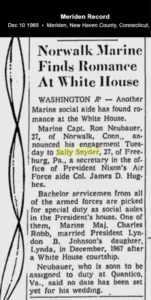
One of my favorite engagement announcements is that of an American-born Schischa cousin, Ron Neubauer, born in 1942. According to the announcement, Ron was a U.S. Marine Corps captain assigned to the White House, and his fiancée, Sally Snyder, worked there as a secretary. It was 1969 and they had met at the White House during the presidency of Richard Nixon.¹⁰ If the couple had looked out of a White House window on November 15–16, 1969, they might have seen me demonstrating in the Moratorium to End the War in Vietnam War, the largest antiwar protest in U.S. history.
If a marriage lasted for 50 years, it might be mentioned in a Goldene Hochzeiten (Golden Weddings) notice.
Obituaries
Austrian obituaries typically provided the name of the deceased, including the maiden name for a married or widowed woman; profession (usually for men); death date; age; names of surviving spouse, children, and siblings; and sometimes the names of grandchildren. They also announced funeral arrangements. These obituaries are now indexed on GenTeam and JewishGen with a link to the original newspaper page. Obituaries were paid notices, usually submitted by a close family member. Occasionally more than one obituary appeared for the same individual as businesses announced the death of an important employee.
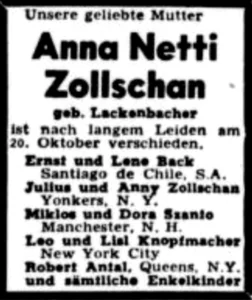
The obituaries of some refugees who died after the Holocaust provided the new residences of survivors. This is especially useful for families with relatives on different continents. For example, the death notice of Anna Netti Zollschan née Lackenbacher (1873–1954) published after her death in New York City noted that one of her children lived in Santiago, Chile.¹¹
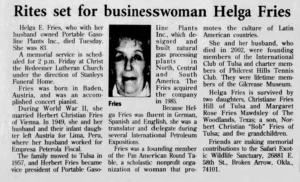
More recent death notices may also include photographs, adding a visual dimension to the record. At times, a modern obituary is so well written it can stand in for a full biography. This is particularly true for death notices of women, such as Schischa family member, Helga Fischer Fries, whose accomplishments received little attention during her lifetime but were captured in her obituary published in a Tulsa, Oklahoma, newspaper.¹²
Case Study: Wilhelm Schischa — From Self-Representation to Erasure in the Press
A clear understanding of the historical and economic context of the time period is essential for interpreting newspaper articles accurately. Without it, routine notices can be misread and shifts in tone may appear arbitrary rather than responses to larger forces. The press record of Wilhelm Schischa illustrates this point.
Wilhelm Schischa, born in Gloggnitz, Austria, on October 11, 1883, became a master tailor in Wiener Neustadt in 1907, 17 miles away. The next year, he married Johanna (Hanni) Friedman. They became the parents of Eduard in 1914 and Karoline in 1927.¹³
Before the Nazi takeover, Wilhelm Schischa appeared in the press as an ordinary participant in Austria’s economic life. His first advertisement, published in 1912, revealed that he operated a shop at Pfarrgasse No. 3 in Wiener Neustadt, where he produced and sold a wide range of men’s and boys’ clothing.
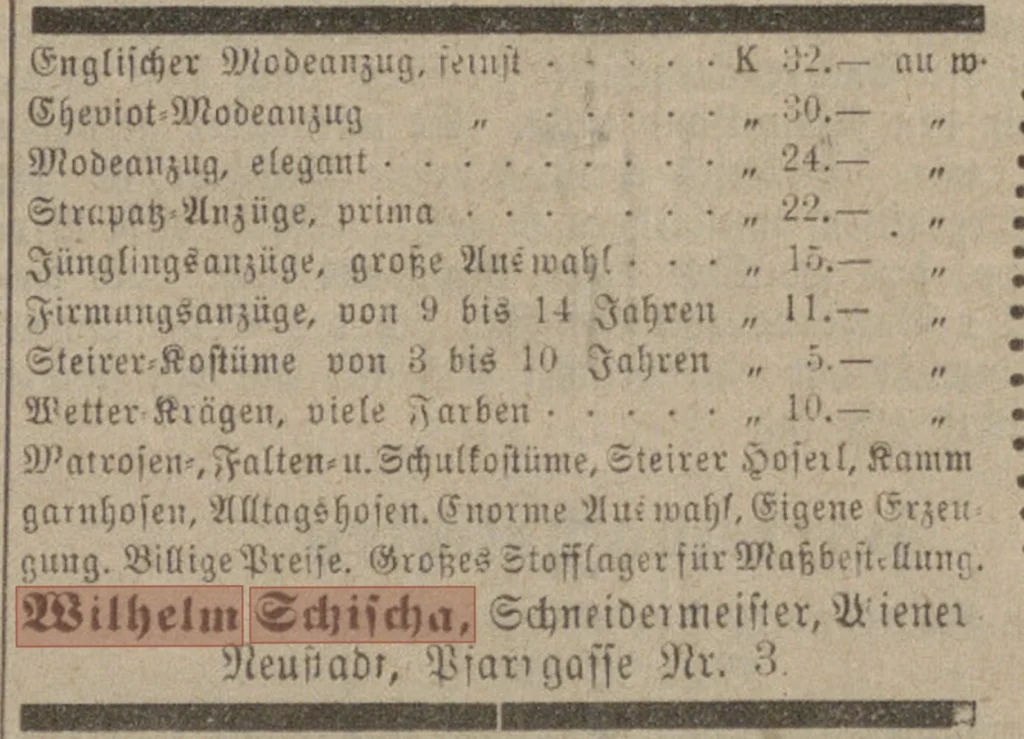
He offered everything from fine English-style suits and cheviot suits to durable work suits. He also advertised confirmation suits for boys, traditional Styrian costumes, and a variety of everyday garments, including sailor and school outfits. The notice emphasized a large selection, in-house production, and a warehouse of fabrics for custom orders. He listed the prices in ‘K’ (Kronen), the currency of Austria until 1924 when it was replaced by the Schilling. Nothing in the advertisement marked him as Jewish or distinguished him from other small businessmen.¹⁴
Wilhelm’s advertisements appeared at least four times per year but the emphasis changed to pricing early on:
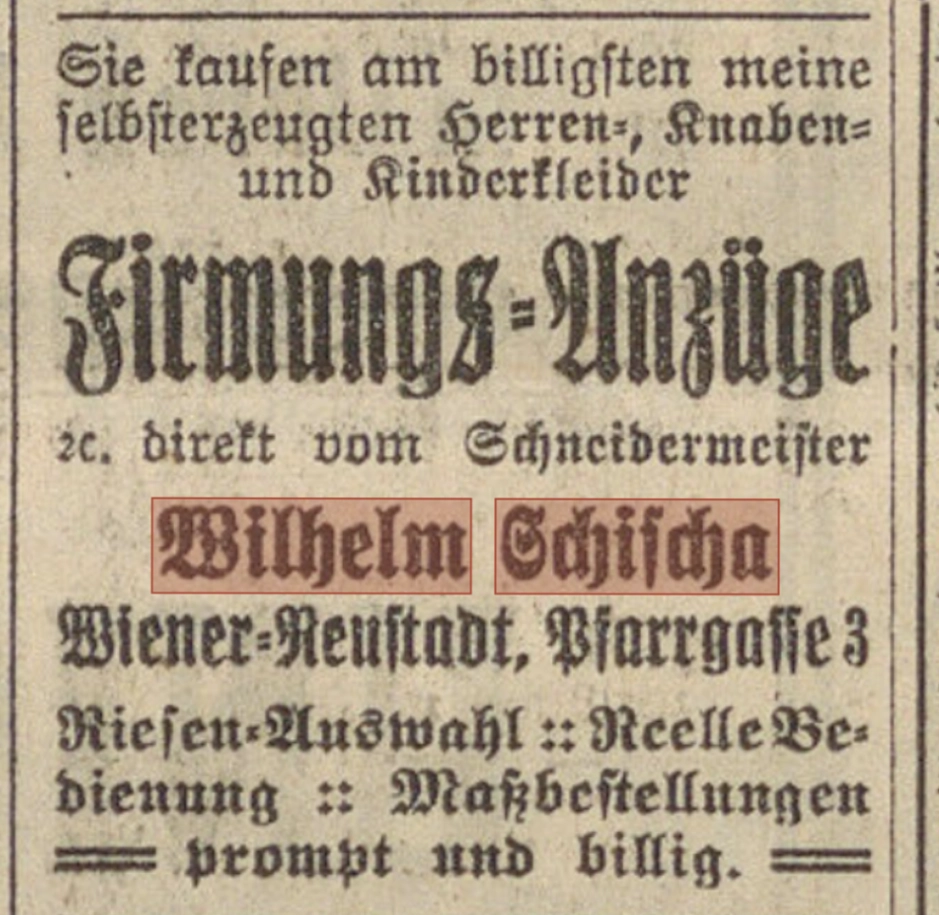
Confirmation suits, etc., directly from the master tailor
Wilhelm Schischa
Wiener Neustadt, Pfarrgasse 3
Large selection – Excellent service – Custom orders completed promptly and affordably¹⁵
Crime reports revealed that Schischa’s store was robbed three times in 1915: In February, a gang of teenage thieves stole nine pairs of trousers during a crime spree that included other local stores. On November 4, Wilhelm’s store alone was targeted: a green coat displayed outside the shop, together with a mannequin, was stolen, followed by a brown coat on November 8. Police caught the perpetrator—an auxiliary worker employed in a munitions factory.¹⁶
In April 1916, the tone of the ads changed once more as Wilhelm targeted laborers:
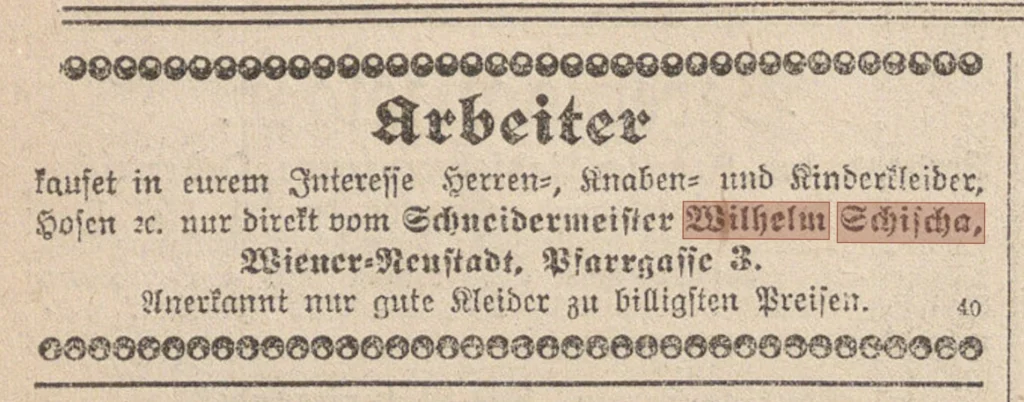
Buy, in your own interest, men’s, boys’, and children’s clothing, trousers, etc., only directly from the master tailor Wilhelm Schischa, Wiener Neustadt, Pfarrgasse 3. Recognized as offering only good clothing at the lowest prices.¹⁷
The ads in the large regional newspapers ended with a short ad in December 1916:
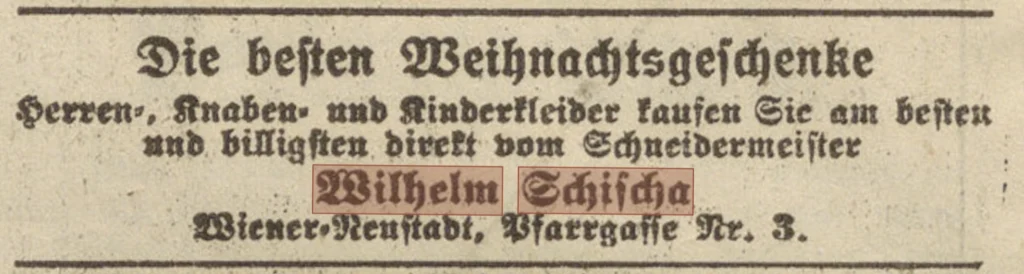
Men’s, boys’, and children’s clothing can be purchased best and most affordably directly from the master tailor
Wilhelm Schischa
Wiener Neustadt, Pfarrgasse No. 3
At first glance, the shift in Schischa’s advertisements from variety and quality to repeated emphasis on low prices and appeals to workers might suggest a routine marketing adjustment. In fact, the wartime economy explains this shift.
At the outbreak of World War I in 1914, Austro-Hungary redirected its civilian economy toward military needs. The government commandeered raw materials and labor for war production, leaving trades such as tailoring with acute shortages. Wool, leather, and cloth were diverted to uniforms, while conscription reduced both workers and customers.
As the war progressed, inflation and scarcity intensified. The government printed money to finance military expenditures, driving up the cost of consumer goods and eroding purchasing power further. For Wilhelm Schischa, reliable supply chains collapsed and many customers could no longer afford his goods.
The scale of the economic breakdown was dramatic. The money supply ballooned from 3.4 billion Kronen at the start of the war to 33.5 billion by October 1918. Hyperinflation worsened with the empire’s defeat and disintegration: in January 1919, one U.S. dollar equaled 16.1 Kronen; by May 1923, that same dollar equaled 70,800 Kronen. Although international relief and austerity measures eventually stabilized the economy, recovery remained uneven, marked by unemployment, social unrest, and intensifying antisemitism. The global depression beginning in 1929 deepened these strains.
Seen in this context, Schischa’s emphasis on “the lowest prices” and his direct appeal to workers were not merely promotional choices but responses to a collapsing wartime and postwar economy.
Wilhelm Schischa’s business endured. He placed ads in at least one small local newspaper but the paper has not yet appeared online. In autumn 1934, he placed five identical ads in the Wiener Neustädter Zeitung, marking his 27 years in business.¹⁸
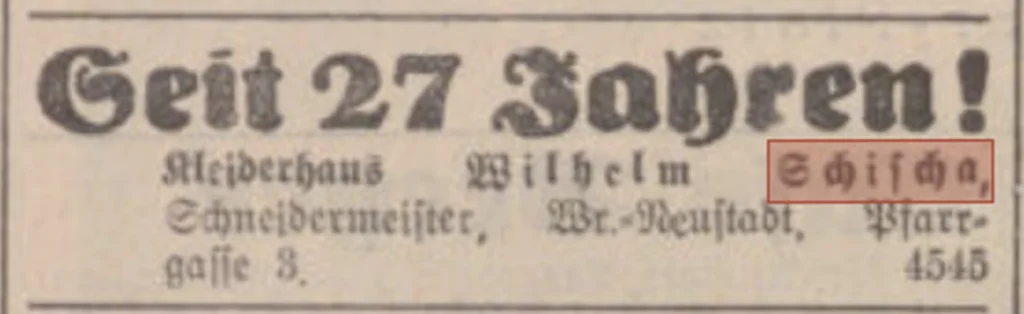
By this time, he identified his firm as the Kleiderhaus Schischa (Clothing House Schischa). One of his last notices appeared in the same newspaper in October 1936, promoting a silk-lined winter overcoat and noting a change in the street name:
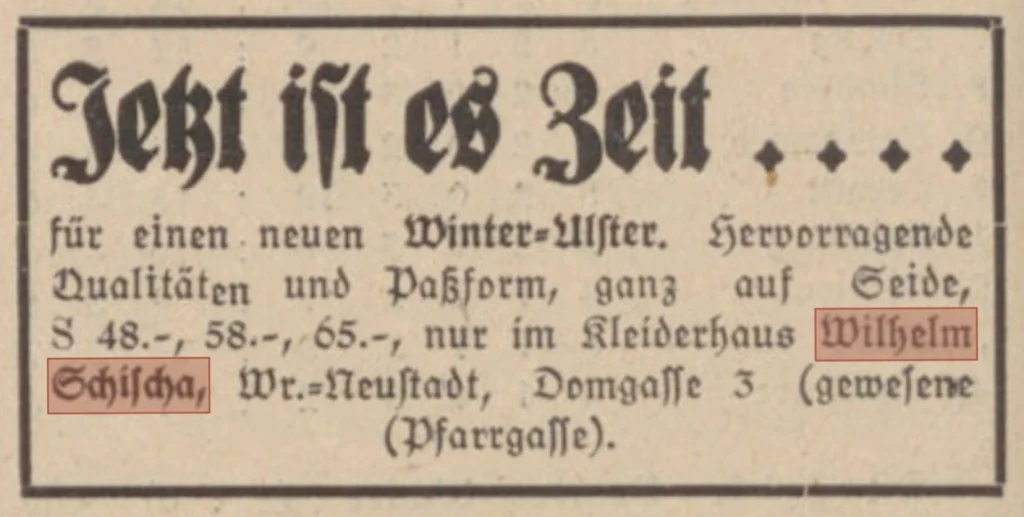
for a new winter overcoat. Outstanding quality and fit, fully silk-lined
48, 58, 65 Schillings — only at the clothing house
Wilhelm Schischa,
Wiener Neustadt, Domgasse 3 (formerly Pfarrgasse).¹⁹ ²⁰
After the Anschluss in March 1938, when Austria joined with Nazi Germany, the Nazi authorities began to dismantle the economic lives of Jewish residents, including Wilhelm Schischa. The Wiener Neustädter Zeitung, the same newspaper that had carried some of his last advertisements, now recorded actions taken against him and other Jewish business owners. In January 1939, it published a list of more than 30 business owners, apparently all Jewish, who had surrendered their trade licenses, presumably unwillingly, in December 1938. Among them was Wilhelm Schischa, who was compelled to relinquish his trade license for his business at Domplatz 3.²¹
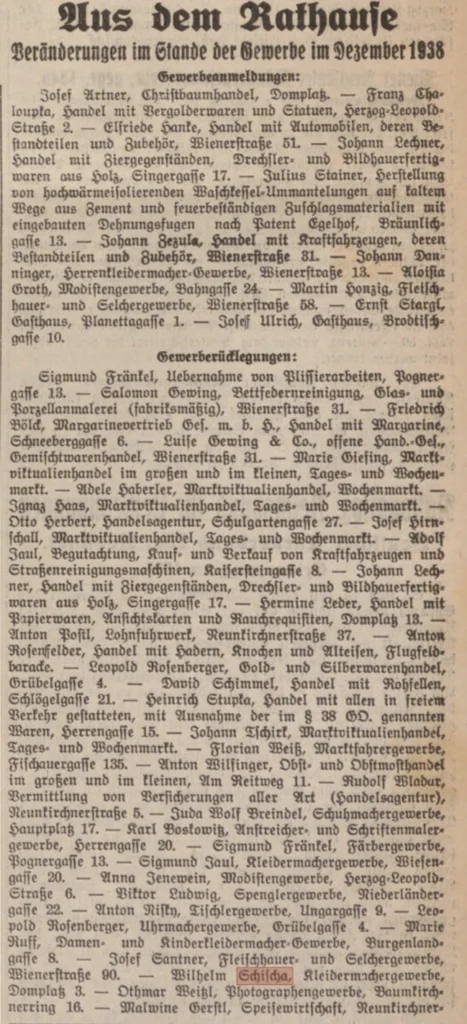
Changes in the state of trades in December 1938
Relinquishment of business
Wilhelm Schischa
By December 1940, the press documented some of his remaining assets. The Völkischer Beobachter, the official newspaper of the Nazi Party, published details of his life insurance policy, originally issued in 1927 and naming his wife Johanna as beneficiary. At the end of the article, he was identified as “Wilhelm Israel Schischa” and gave his address as Scheuchgasse 19/4 in Vienna’s 9th district. (Legislation passed in August 1938 forced Jews to adopt the middle name of Israel for males and Sara for females if they did not have recognizably Jewish first names.) The notice listed the policy’s value in Reichsmarks, evidence that the authorities were tracking—and preparing to seize—Wilhelm’s financial assets.²²
During Kristallnacht in November 1938, the Nazis forced the Wiener Neustadt Jews from their homes and arrested them. Those who were not sent to Vienna prisons or Dachau concentration camp were expelled to Vienna. This newspaper article, stripped of context and written in bureaucratic language, reveals where Wilhelm Schischa had been driven.
Wilhelm Schischa’s name appeared in the Austrian press one final time. In 1948, his daughter, Karoline Schischa, who had escaped to England via Kindertransport, initiated proceedings for declaration of death for Wilhelm and his wife:
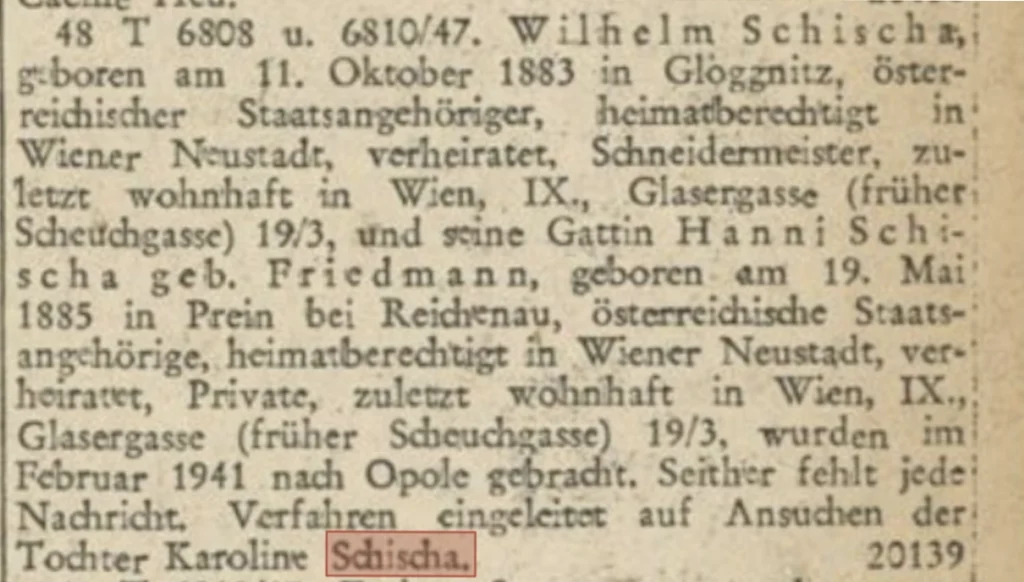
Proceedings were initiated upon application of their daughter Karoline Schischa.²³
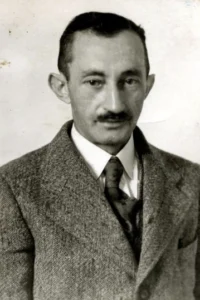
Decades later, Karoline shared her family’s story on Centropa: https://www.centropa.org/en/photo/birth-certificate-lilli-taubers-father-wilhelm-schischa.²³
Post-Holocaust Newspaper Articles
Oskar Löwy had been decorated for his World War I service, but this did not protect him during the Holocaust. Austrian Nazis deported him to the Theresienstadt Ghetto on September 25, 1942, in a transport of 1,300 Jews.²⁴ Shortly after arrival, Oskar—completely blind and defenseless—received a vicious beating from the camp commandant. The incident can be found in the press coverage of the war crimes trial of Siegfried Seidl, the brutal commandant of the Theresienstadt Ghetto from November 1941 to July 1943. Oskar Löwy—who survived the beating and the ghetto—testified at the trial in September 1946:
The witness Oskar Lowy was a Battalion Commander in the Austro-Hungarian army and is the recipient of the Golden and Silver Medal for Bravery, and because of his wounds he is totally blind. When he arrived in the transport to Theresienstadt, he heard the screams and shouts of the other prisoners [being beaten] with whips and clubs. He asked to be taken in front of the leader on the station platform; he was led to Dr. Seidl, to speak with him. He told Dr. Seidl that he was blinded in war and had received the highest decoration of World War I. A terrible whipping was his only answer.
The State Attorney, shocked, asked the accused if he would dare to do the same nowadays…
“Yes, war-blinded people also had to follow the rules of the Nationalist Social Regime.”²⁵
Seidl was found guilty and hanged for his crimes in February 1947.
The account of Oskar Löwy is exceptional. Far more typical in the postwar press were formal notices announcing that proceedings had been initiated to have missing relatives legally declared dead, such as the one posted by Karoline Schischa above.
Conclusion
Enhancing my family history with personal details from newspapers and journals improved the narrative, bringing depth and context to lives that might otherwise appear only as names and dates.
The 1,298 Schischa hits in ANNO are a gross underrepresentation of the total number of newspaper articles worldwide that pertain to the Schischa clan, as they do not account for the vast majority of name changes resulting from marriage. Since metrical records for the Mattersdorf Jewish community were introduced in 1833, I have been able to track name changes over the past 200 years. Additionally, some men in the patrilineal Schischa line changed their surnames.
When I add these additional surnames into ANNO searches, I must specify first names to narrow the results. Even so, I have added many hundreds more hits to my tally. ANNO itself captures only part of the available record. The subscription-based newspaper databases, OldNews.com and Newspapers.com, extend the geographic reach significantly, especially for the United States, Canada, Australia, and parts of Europe. There are many more databases I intend to explore.
Around 1800, my fourth great-grandfather, David Schischa became David Löwy because at least one cousin had the same name. The change resolved an immediate problem of identification but created a lasting complication. My grandfather, Dr. Moriz Löwy, should have been Dr. Moriz Schischa and my mother, Melitta Schischa. The family line would be clear and continuous. Instead, the alteration created a break that I have had to clarify over and over in my research. People tend to connect more readily to relatives whose surnames match those of their parents. When they do not, the relationship feels more distant.
The number of compelling stories already uncovered is striking. This unexpected richness has created an unexpected problem: how to choose which stories for inclusion. Some family members today are averse to revealing episodes that they believe reflect poorly on their ancestors. The question I weigh is whether recounting negative stories risks fueling the already dangerous persistence of Jew-hatred today. Happily, the percentage of criminals in the family is extraordinarily low.
Before the rise of Hitler, relatively few Schischas had emigrated from Europe, so the Holocaust had a devastating impact on the family. The surviving family members became part of the greatest migration in Jewish history. Today, members of the Schischa clan are scattered worldwide. A majority live in Israel and a sizable number reside in the United States. I have discovered many others in Argentina, Australia, Austria, Canada, Ecuador, England, France, Germany, Hungary, Italy, Mexico, New Zealand, Norway, Scotland, Spain, Sweden, and Switzerland.
During the Shoah, a few survivors initially fled to Brazil, Bolivia, Chile, China, Colombia, Cuba, Ecuador, the Dominican Republic, Haiti, Japan, Macau, Northern Ireland, Paraguay, Peru, Portugal, South Africa, and Venezuela before moving on. Newspaper stories are likely waiting to be found in all these places.
Carole Vogel has written 25 nonfiction books, edited We Shall Not Forget: Memories of the Holocaust, a 500-page volume containing 42 essays, and published 11 articles in AVOTAYNU. Her current focus is the multi-century history of the Schischa family from the Jewish community of Mattersdorf, Hungary (now Mattersburg, Austria). Vogel lives in Branchville, New Jersey.
Endnotes
¹ https://carolegvogel.com/magazine-articles/anchoring-the-schischa-family-firmly-in-austro-hungarian-history-during-the-1600s
² Jakob Levy is CGV’s eighth-great-grandfather.
³ The Mattersdorf Jewish community records included details on occupations, tax obligations, status, disputes, fines, religious roles or community responsibilities, donations, as well as charitable activity, property holdings, and last wills and testaments.
⁴ https://carolegvogel.com/magazine-articles/constructing-a-town-wide-genealogy-jewish-mattersdorf-hungary-1698-1939/
⁵ “Martha Sadumischker, geb. Verblum,” death notice, Berliner Tageblatt, Jan 1, 1922; reporting her death on Dec 30, 1921 at age 63 and burial in the Jewish Cemetery in Weissensee. Note: The surname Sadunischker and maiden name Verblun were misspelled. (Berlin, Germany).
⁶ Sadunischker-Ricklowitz engagement. Berliner Tageblatt, 21 Aug 1910. (Berlin, Germany).
⁷ I knew that every Schischa with Jewish ancestry in the Austro-Hungarian Empire belonged to my clan. A relatively small number of Christians named Schischa appeared in the records, but they were easily identified by their Christian given names and by cross-checking against Catholic baptism records in GenTeam and Ancestry. Schischa also means “waterpipe” in German, and a very small number of matches were for advertisements relating to hookahs.
⁸ I remember seeing the Aufbau on the coffee table of my grandparents.
⁹ Weinberger–Rubinstein marriage proclamation, Neues Wiener Journal, Oct 19, 1898. (Vienna). Hungarian and German.
¹⁰ “Norwalk Marine Finds Romance at White House.” Meriden Record. Dec. 10, 1969. (Meriden, CT).
¹¹ Anna Netti Zollschan obituary. October 1954, New York City. [Note: this is likely from Aufbau.]
¹² Helga Fries obituary, Tulsa World, Mar 3, 2006. (Tulsa, Oklahoma).
¹³ Schischa-Friedman marriage record. Nagymarton marriage registrations 1902–1920, FHL INTL microfilm #0700403, p. 4 entry 27.
¹⁴ “Wilhelm Schischa, Schneidermeister.” Gleichheit, Mar 15, 1912. (Austria)
¹⁵ “Firmungs=Anzüge Wilhelm Schischa.” [Confirmation suits Wilhelm Schischa.] Gleichheit May 29, 1914. (Austria)
¹⁶ “Diebstähle.” [Thefts.] Gleichheit. Nov 19, 1915. (Austria)
¹⁷ “Arbeiter.” [Workers.] Gleichheit 14 Apr 1916. (Austria)
¹⁸ “Seit 27 Jahren.” [For 27 years.] Wiener Neustädter Zeitung, 22 Sep 1934. (Austria)
¹⁹ “Jetzt ist es Zeit” Wiener Neustädter Zeitung, 10 Sep 1936. (Austria)
²⁰ In the book Lebenslinien: Jüdische Familien und ihre Schicksale. Eine biografische Reise in die Vergangenheit von Wiener Neustadt by Werner Sulzgruber (Berger & Söhne Verlag, 2013) there is an ad from 1937 but it was not referenced and I could not find it online.
²¹ “Aus dem Rathaus.” From City Hall. Wiener Neustädter Zeitung. Jan 21, 1939. (Austria)
²² “Amtlicher Teil: Aufgebot von Wertpapieren.” [Official Section: Public Notice of Securities.] Völkischer Beobachter, Dec 11, 1940. (Vienna)
²³ “Verfahren zur Todeserklärung.” [Procedure for Declaration of Death.] Wiener Zeitung, Mar 16, 1948. (Vienna)
²⁴ Oskar Löwy Theresienstadt Ghetto registration card. Born: Sep 13, 1894. Transport IV/11 Wien [Sep 25, 1942.] Arolsen.
²⁵ “Kriegsauszeichnungen galten im KZ nichts.” [War awards meant nothing in the concentration camp]. Wiener Kurier. Sep 28, 1946, p. 3. Translated by Rodolfo Kohn. (Vienna)