An Unlikely Friendship
by Carole G. Vogel

When I met Inge Franken at a One-by-One Dialogue Group in 1996, she was the black sheep of her family. Her mother and sister were annoyed and threatened by her persistent attempts to learn the truth about her father’s Nazi past. Inge’s four children could not understand the purpose. One daughter told her, “I have no connection with your past and the crimes of the Nazis.”
As Inge became more involved with her work, the conflicts worsened and her sister and two of her children distanced themselves from her. Other family dynamics came into play, too, but the toppling of the war-hero image of Inge’s father was particularly damaging to Inge’s relationship with her sister. Interestingly, over time Inge’s mother finally owned up to the truth and to her own role in supporting the Nazi ideology. Before she lost her identity to dementia, the mother had reconciled with Inge and was able to express how proud she was of Inge’s work.
Inge Franken was probably best known by German One-by-One members as one of the chief organizers of the Sonntagstreffen (Sunday meetings), which occurred monthly at a community building on Fehrberliner Strasse in Berlin-Prenzlauer Berg. Here people from both sides speak about the impact of the Holocaust on their lives and new people come all the time, seeking dialogue with the other side. Sonntagstreffen are held in the same building that once housed the Jewish children’s home. When Inge discovered this in 1998, she wanted to learn the fate of the children. To her consternation she found virtually no information so she decided to document their fate herself. Her greatest challenge was acquiring the needed research skills. This she did over a five-year period.
The Jewish children’s home was established in 1910. Most youngsters who lived there were sons and daughters of working parents; only a few were orphans who stayed there overnight. In the 1930s, it sheltered children of concentration camp inmates. The Nazis shut down the orphanage in 1942 and more than 50 residents and their adult caregivers were killed. In her meticulously researched book, GEGEN DAS VERGESSEN: Errinerungen an das Judische Kinderheim Fehrberliner Strasse 92 Berlin-Prenzlauer Berg (Against Forgetting: Memories of the Jewish Children’s Home….), Inge Franken captured the spirit of the Kinderheim and documented the existence of its occupants. She drew a striking portrait of the short lives of the home’s Jewish children as Nazi terror descended on them.
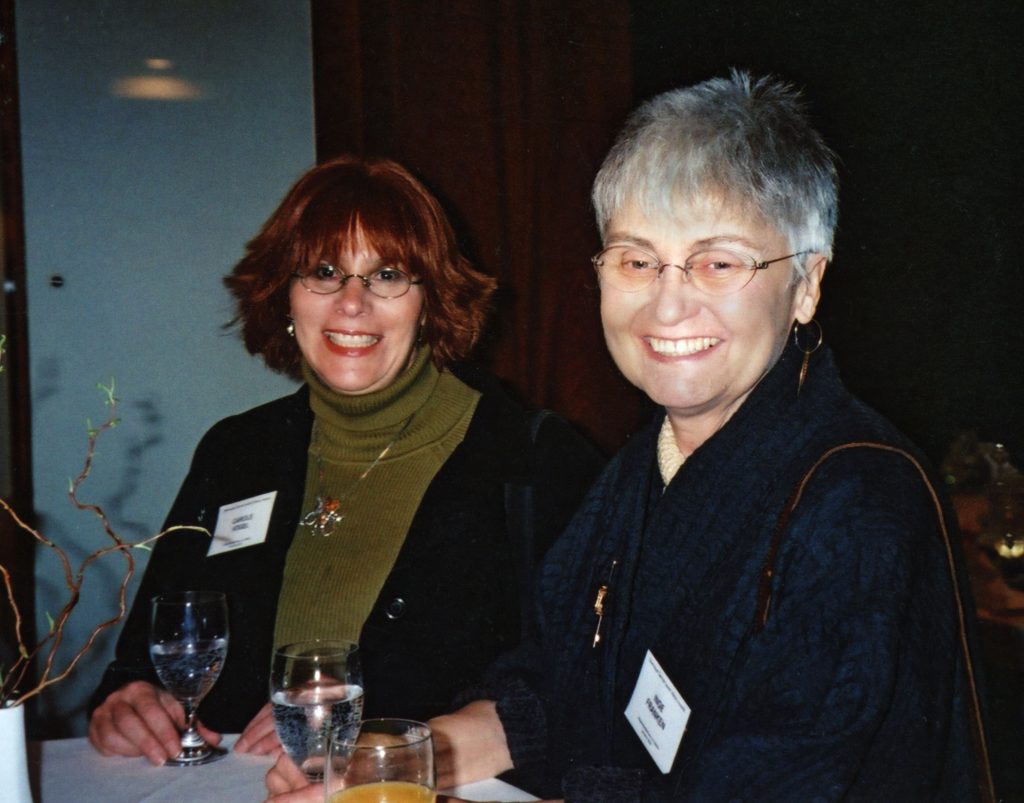
Inge Franken was born in 1940 in East Prussia. Her father was a teacher and ardent Nazi supporter. He joined the NSDAP in 1933 and became a member of the SA. At the outset of World War II, he fought with the German Army, first in Poland, then in France. After undergoing officer training, he was transferred to the Russian front and participated in the Leningrad siege. In 1942, he died in battle.
Inge grew up idolizing her father. As a teenager, she traveled to Amsterdam with some schoolgirls and was shocked when a hostel manager denied them admittance because they were Germans. This event ignited Inge’s search for the truth; first about the war, and then about her father. Initially her mother was unable to talk, but eventually she shared the father’s wartime letters, which revealed his Nazi sympathies.
Inge became a teacher in Berlin Neukölln. In 1987 the local Heimat Museum asked teachers to uncover traces of past Jewish life in their school’s neighborhood for a large exhibition marking the 50th anniversary of Kristallnacht. Inge worked with six students, and their project resulted in the self-published booklet, Spuren [Traces], which identified houses and businesses near the school that had been seized from their Jewish owners, and documented the fate of some of the Jews who had once called the community home. This project won high praise, and Inge and her students received a prize of 8,000 DM from the Harold Bob Foundation.
In 1996, Inge joined a dialogue group sponsored by One-by-One. This is where I met her. Her family had supported Nazi ideology; my Jewish family paid the price of Hitler’s vision. Both of us were former teachers and our desire to educate the younger generation propelled us to participate in One-by-One’s Speaker Bureau, where side by side we put a human face to the consequences of genocide and served as a model for the possibility of dialogue for other polarized groups. From 1996 until her death 16 years later, Inge organized most of the One-by-One presentations in German schools. One-by-One has visited more than 25 schools in Berlin, Brandenburg, and Nuremberg, ten of which requested yearly presentations. Inge and I teamed up for school visits in Germany and the U.S. and I can attest to her remarkable ability to reach students in both countries.
In 2003, Inge and her colleagues prepared a permanent exhibition in the former Kinderheim. It included some compelling photographs of the Kinderheim children taken in 1934 and 1936 by the Jewish photographer Abraham Pisarek, who documented Jewish life during the Nazi era. In 2006, Inge and friends expanded the exhibit with additional photographs from Pisarek and other sources. The building is now registered on the list of historical memorials in Berlin and open for public tours on Tag des Offenen Denkmals. Informal tours are given whenever requested.
Inge’s work was not finished. She directed her focus to the Stolpersteine project. She placed little metal stone-shaped plaques in the sidewalk in front of the last home of Tosca Kempler, a Kinderheim survivor, who lost her parents and two siblings in the Holocaust. Each stone bore the name of one of the murdered family members. If Inge could have arranged the funding, she would have placed Stolpersteine in front of the former homes of every occupant of the Kinderheim who died or lost their families during the Holocaust, and in front of the homes of the murdered families of her Jewish friends from One by One.
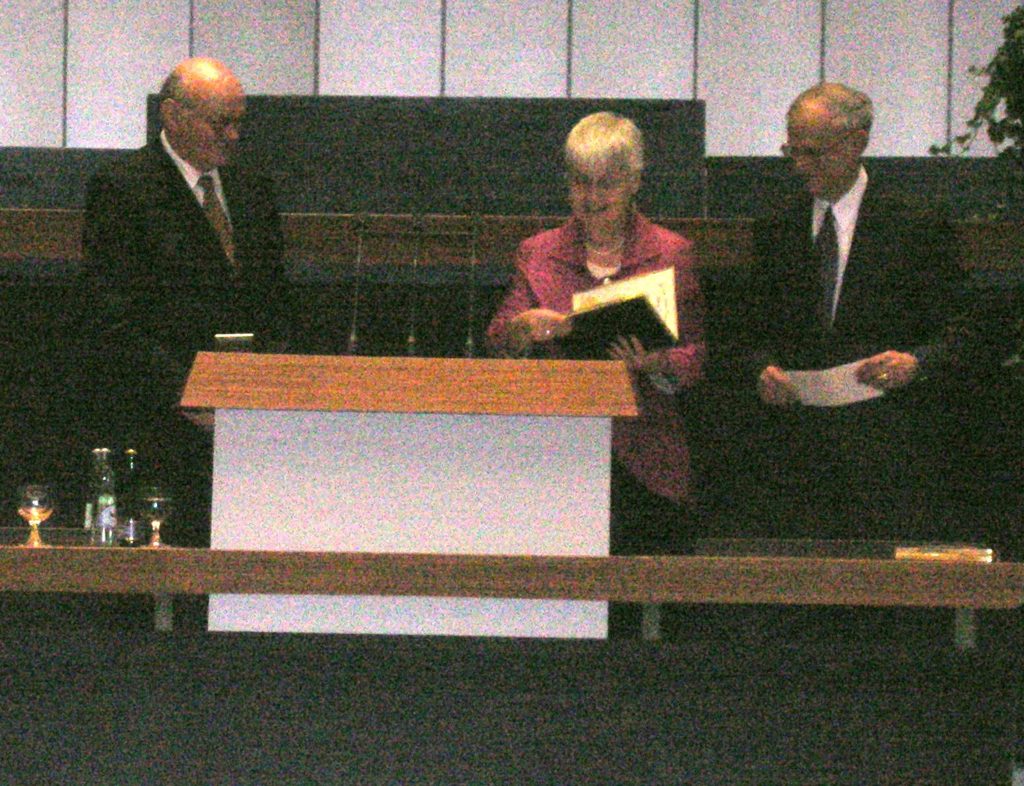
In 2007, Inge won the prestigious Obermayer German Jewish Award, a prize given annually to five Germans who have made extraordinary contributions to preserve and record the Jewish history, culture, and remains of their local community, all on a voluntary basis. The prize included a 1000 Euro cash award and two days of jam-packed activities in Berlin with other winners and the people who had nominated them. There were elegant luncheons and dinners, a tour of Berlin’s historic Jewish sites, interviews with the media, and it all culminated in an awards ceremony at the Abgeordnetenhaus Berlin (parliament building).
Inge’s mother was still living, but she was not cognizant enough to understand the implications of the Obermayer Award. Inge’s sister and Inge’s children and grandchildren, however got it. The international recognition of Inge’s work, the award ceremony taking place in such a symbol of power, the politicians present, the 1000 Euros, and later the newspaper article with Inge’s photo, changed the way that Inge’s family regarded her.
Suddenly she wasn’t an eccentric, stubborn old woman with a passion for stirring up trouble. Instead they saw her as a courageous German committed to the truth, a woman who did important works and changed the lives of those she touched. They understood that her work, especially her efforts with German school children had value. They were bursting with pride at the award ceremony. Her 18-year-old grandson summarized it best when he said, “Grandma, nothing can ever top this.”
The award ceremony in Berlin was just the beginning of a weekend-long celebration. The next night there was an immense catered party (held at the former children’s home) with about 60 or 70 people, all friends, including some from One-by-One, or relatives of Inge’s, many from distant parts of Germany and other European countries. It felt like a cross between a wedding and a bar mitzvah, even down to the Russian Klezmer band.
Inge’s partner Ulrich, who had “humored” Inge’s passions when they first met, was just about the proudest man on the planet when Inge was honored. Rarely, have I seen a man take such unabashed joy in the recognition of the accomplishments of his significant other. Inge told me that she felt like she was floating on air that weekend. Ulrich was floating right up there with her.
At the reception, speeches were given by those closest to Inge and they were heartfelt and passionate but the most moving was the one given by her sister. The sister made it clear that she had been an unwilling participant in Inge’s journey but now recognized the value of Inge’s work and she could finally appreciate what an incredible human being Inge is. My words don’t do this speech justice but suffice it to say that there were a lot of teary-eyed people in the room by the time the sister finished speaking.
I asked Inge to reflect on getting the award. Inge’s own words are as
follows (she asked me to clean up her grammar and spelling):
“To receive the 2007 Obermayer award this year in Berlin was the most important thing that has happened to me in my life. I never thought this could happen to me. I am only a very normal German woman who feels the connection with the terrible past of her country. What I have done over the past 20 years has helped me live better with the guilt feelings, which I had in the years before.
“My research projects brought me in contact with wonderful people who now live far away from Germany but who all have their roots in Berlin, my home. The work brings us together and we help each other by carrying the suffering together. So now I have very good friends in the U.S. and Israel and these relationships are much deeper than I could ever believe possible.
“That I got the award showed my four children that it is important for the former victims of the Third Reich and their descendants that we Germans research our past. My children said to me that they are proud that you in America saw the value of my work.
“The Obermayer Award empowered me to continue researching the Stolpersteine in Berlin and it re-energized my desire to meet with students and to speak with adults about their connection to the Nazi past, either as participants or as the descendants of perpetrators, victims or bystanders.
“The Obermayer Award gave me much more power within the family. I am more proud of what I am doing and I feel better about it. The award sent me a powerful message telling me that I should go on with my work, that it is important work.”
Inge’s work touched my family in a more profound way than I ever imagined. Inge had discovered that my father’s aunt, uncle and 14-year-old cousin had lived on the same street in Berlin where one of Inge’s daughters now lives. The aunt, uncle, and cousin had been deported to Auschwitz where they all perished. Inge decided to research the family and raise money for three Stolpersteine to be placed in front of their former residence.
A few days before the Obermayer Award, Inge and I had spoken together to a couple of classes in a Berlin school. Inge recruited two of the teachers and four of the students to help her with this Stolpersteine project. Inge also issued an invitation to my family to come to the Stolpersteine dedication.
I was unable to make the trip but my older sister Vivian Prunier knew instantaneously that she had to attend in my stead. This is the same sister who had refused to step foot on German soil for her entire life and who told me I was crazy to forge friendships with children of Nazis. Vivian decided to bring along her husband Tom, daughter Sarah, and son-in-law David. I was glad I could not go because my absence forced Vivian and her family to take ownership of the event.
Inge expected about a dozen people besides my family to attend the dedication – the four students, the teachers, a few friends and relatives. She was stunned when 50 people showed up, including a number from the neighborhood and several current residents of the building where my family had lived.
Inge and the students prepared a booklet with documents relating to my murdered relatives and they wrote some very moving statements, which they read aloud at the ceremony. My sister and her family too had a lot to say, much of it extemporaneous and spoken haltingly through the tears. This was one of the most profound experiences of their lives.
One man who was resident of the building expressed his sincere thanks for the proceedings. He said that he had known that Jews had once lived there and that he was curious about them but never knew how to find out who they were and their fate. He invited Inge and my family to see the inside of the residence.
Inge touched my life in other profound ways. She arranged a tour for me of Terezin, the garrison city that the Nazis had turned into concentration camp Theresienstadt. My great-grandmother Franziska (Fani) Löwy née Kohn and at least a dozen other relatives perished there and it took a lot of courage for Inge and her partner Ulrich to accompany me. We located the building where Fani had been confined and the hospital where she succumbed to starvation and typhus. The hardest moment came in the crematorium. I had thought that the Germans had blown up the crematorium in the waning days of the war. I was wrong. This facility was in pristine shape, all four ovens used to burn up dead Jews stood there, in working order, ready to be fired up again. When I entered the building my knees buckled and Inge and Ulrich caught me before I hit the floor.
Inge Franken died unexpectedly in her sleep in September 2012 and I have been missing her ever since. All friends touch your life, but only a rare few can profoundly change your life’s course. My younger self would be astounded that I am grieving the loss of a German woman whose father was a Nazi zealot. I am immensely grateful to One-by-One for bringing us together.
Published in Journeys of Transformation: Confronting the Legacies of Conflict, War and Genocide by Wilma Busse et al. One by One, Inc., 2023.